Kanuti Hot Springs
By the HotSpringsFind editorial team · How we compile records · Reviewed September 2026
Kanuti Hot Springs is a primitive hot spring listed near Bettles, Alaska. Reported soak temperature: 105°F. See the visit fact sheet.
Current status
True wilderness hot spring 15 mi north of the Arctic Circle in the Kanuti National Wildlife Refuge/BLM conservation area — two natural pools with 110-151F source water (soak near cold inflows), ~12-14 mi from Dalton Highway MP 103 with NO marked trail: reach it by a ~14-mile packraft float down the Kanuti River, a cross-country hike over Caribou Mountain, or a hard winter ski/snowshoe.
Checked September 2026 · based on recent visitor reports · 6 sources ↓
Before you go
- Status: Open — last verified below — confirm via UAF/Alaska Science Forum — Alaska hot springs, far and wide (ski trip, ~13 mi from Dalton crossing).
- Cost: Reported free access — fees and permits can change, confirm before visiting.
- Getting there: No verified hike distance on record — confirm the route and road conditions.
- Water: Reported soak temperature 105°F — always test the water before entering.
- Rules: Reported clothing-optional; pets reported not allowed — confirm current rules.
- Conditions: check weather, fire closures, and land-manager alerts the week you go — mountain access changes seasonally.
- Reservations/permits: None required — free access within Kanuti NWR/ACEC; standard refuge rules (no motorized access off-highway except snowmachines where allowed).
- Best time to go: Summer (June-Aug) for the river float/hike — expect mosquitoes and possible low water; March-April for ski trips before deep cold but with daylight. Essentially never crowded.
- Clothing reality: No policy — extremely remote wilderness; clothing-optional in practice.
- Cell service: none — download maps and tell someone your plan.
- Accessibility: Not accessible — multi-mile off-trail wilderness travel or river float; no infrastructure whatsoever.
- NO marked trail — carry the Bettles B-2 topo quad and know how to navigate; multiple parties report route-finding difficulty through brush/tussock country
- Standard approach: ~14-mile float down the Kanuti River from the Dalton Highway MP 103 crossing (packraft; low water = dragging), then a cross-country hike back out over Caribou Mountain — or ski/snowshoe ~11.5-13 mi in winter
- Winter access is a serious Arctic undertaking — deep snow, severe cold, short daylight; for experienced winter travelers only
- Source temps 110-151F — soak where cool water mixes in; cyanobacteria mat colors (white/yellow/orange) mark the hottest zones
- Completely undeveloped — no facilities, signage, or emergency infrastructure; carry all food/water/satellite comms
- Primitive backcountry camping allowed in the refuge; nearest developed camping is BLM's Arctic Circle Campground (~15 mi)
- Area of Critical Environmental Concern — treat the cyanobacteria mats and sinter formations as fragile; no soap
- Grizzly bears — full Arctic refuge bear precautions; mosquitoes brutal in summer
- Dalton Highway MP 103 is the jump-off — a remote gravel haul road ~200+ mi north of Fairbanks; nearest town/services are far (Healy ~174 mi)
- Hazard: Off-trail navigation through tussock/brush country — easy to get lost
- Hazard: Scalding source pockets up to ~151F
- Hazard: Grizzly bears
- Hazard: Arctic winter cold/dark for ski approaches
- Hazard: Low-water river channels can require dragging boats
- Hazard: No cell service; days from rescue — carry satellite communicator
- Hazard: Heavy mosquitoes in summer
About this spring
Wild geothermal pools ~15 mi north of the Arctic Circle inside Kanuti National Wildlife Refuge — source temps 110-151°F mixing into grassy boreal pools. Classic packraft trip: float ~14 mi down the Kanuti River from Dalton Hwy MP103 then hike out. No trails, no facilities, no rescue services; source water scalds — find mixed pools.
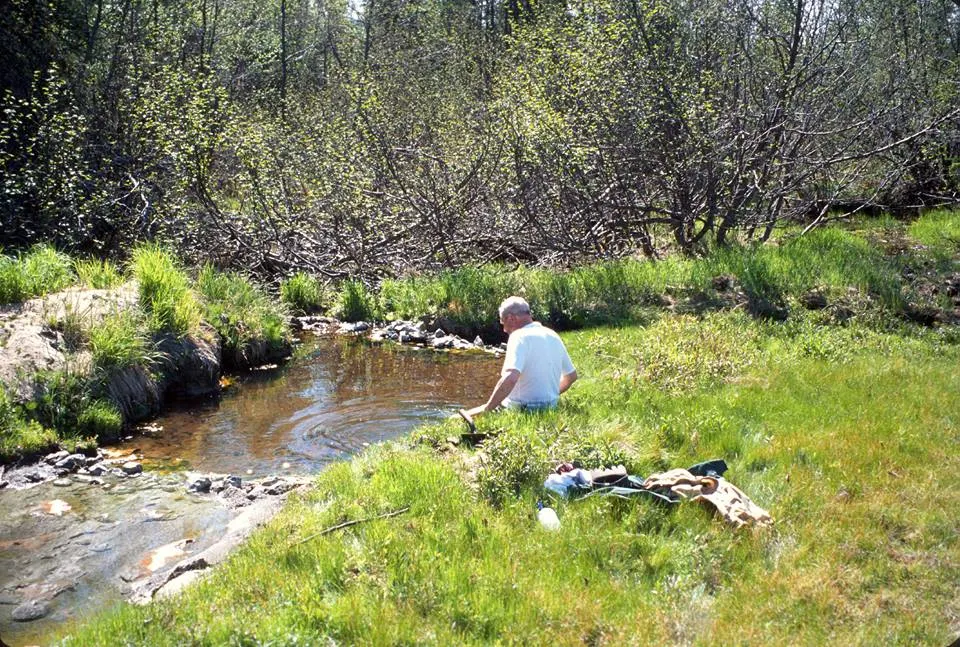
Kanuti Hot Springs is a true wilderness spring about fifteen miles north of the Arctic Circle, inside Kanuti National Wildlife Refuge — source water measured between 110 and 151°F mixing into grassy boreal pools. The classic approach is a packraft trip: float roughly fourteen miles down the Kanuti River from the Dalton Highway crossing at milepost 103, then hike out. There are no marked trails, no facilities, and no rescue services.
This is genuine remote-country travel — multiple parties report route-finding difficulty through brush and tussock country, so carry the Bettles B-2 topo quad and know how to use it. Source water scalds; soak near the cold inflows. June through August suits the float-and-hike but brings mosquitoes and possible low water; March–April ski trips trade bugs for deep cold and better light. An air charter via Bettles is the alternative.
Directions & trailhead access
Dalton Hwy MP103 (Kanuti River crossing); packraft 14 mi downriver or bushwhack. Air charter via Bettles.
Alaska geothermal context
Alaska's geothermal sites sit along the volcanically active Aleutian arc and scattered Interior fault zones. Most are reachable only by floatplane, boat, or long backcountry routes, and the realistic soaking season is short — roughly June through September. Treat every remote spring as a wilderness trip, not a roadside stop.
What a primitive site means here
Primitive springs have no facilities: no changing rooms, no trash service, often no maintained road to the pool. Expect natural rock or gravel bottoms, water temperature that varies by spot and season, and other visitors who may treat the site informally. Pack out everything you bring, test the water before entering, and leave the pool cleaner than you found it.
Best time to visit
June – September (Short Summer Access Window)Remote Alaskan geothermal sites have a brief accessible season — snow, ice, and limited road access close most areas outside summer. Midnight-sun June through early September offers the only realistic visiting window for most locations.
Fact sheet
| Reported soak temp | 105°F |
|---|---|
| Source temp (historical) | 105°F |
| Trail access | Recorded coordinates — access unverified |
| Access fee | Reported free — verify locally |
| Clothing policy | Reported clothing-optional |
| Pet policy | Reported no pets |
| Geothermal data reference | NOAA Thermal Springs List (1980 archive) |
| Check land status | UAF/Alaska Science Forum — Alaska hot springs, far and wide (ski trip, ~13 mi from Dalton crossing) |
Kanuti Hot Springs FAQ
Is Kanuti Hot Springs open right now?
True wilderness hot spring 15 mi north of the Arctic Circle in the Kanuti National Wildlife Refuge/BLM conservation area — two natural pools with 110-151F source water (soak near cold inflows), ~12-14 mi from Dalton Highway MP 103 with NO marked trail: reach it by a ~14-mile packraft float down the Kanuti River, a cross-country hike over Caribou Mountain, or a hard winter ski/snowshoe. (Status based on recent visitor reports, last checked September 2026.)
Is Kanuti Hot Springs free?
Kanuti Hot Springs is listed as free to access in Yukon-Koyukuk Census Area, Alaska. Fees and rules change — verify current status with the land manager before visiting.
What temperature is Kanuti Hot Springs?
Kanuti Hot Springs has a reported soak temperature of 105°F and a historical source temperature of 105°F in survey records. Historical data may not reflect current conditions — always test water before entering.
Is Kanuti Hot Springs clothing optional?
Kanuti Hot Springs is listed as traditionally clothing-optional in directory records. Confirm current rules before visiting, as policies change.
How do you access Kanuti Hot Springs?
Kanuti Hot Springs is on public land — verify current road access, fees and rules with the land manager before visiting.
Sources & references
- Wikipedia — Kanuti Hot Springs (ACEC, 110-151F, Arctic Circle, cyanobacteria) — community · 2025
- UAF/Alaska Science Forum — Alaska hot springs, far and wide (ski trip, ~13 mi from Dalton crossing) — news · 2024
- The Edventures (Ed Plumb) — Re-Doin' Kanuti Hot Springs (winter ski route, 11.5 mi from MP 103) — community · 2008-02
- Go Play Outside — A Kanuti hike and float (packraft trip report) — community · 2012-06
- HotSpringsGuides.com — Kanuti River Hot Springs (14-mi float, no trails, camping rules) — community · 2025
- SoakingSprings.com — Kanuti Hot Springs (BLM Central Yukon FO record, updated Sept 2026) — community · 2026-09
Details above were verified against the named sources on their listed dates — conditions change, so recheck before traveling. · How we verify our data · Report a correction
Your private trip notes
Saved only in this browser — not published or shared.No private notes yet
Keep access details and observations for your own planning.